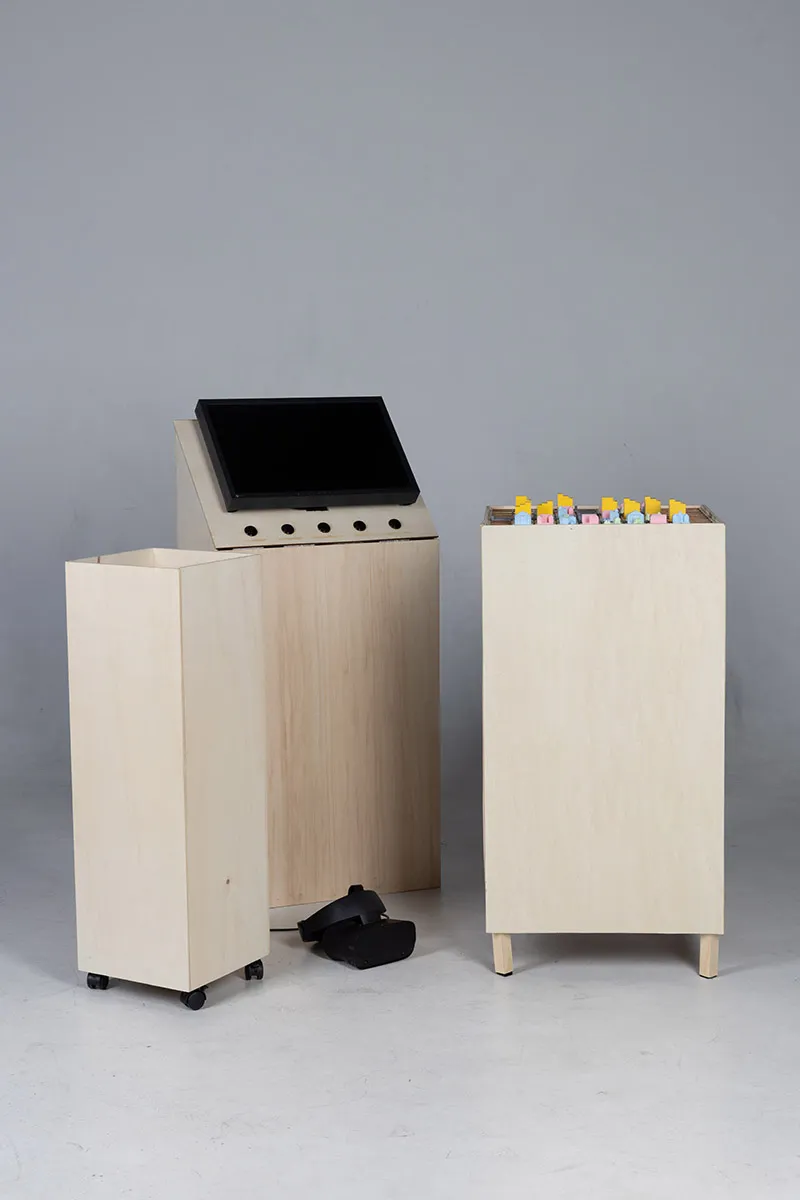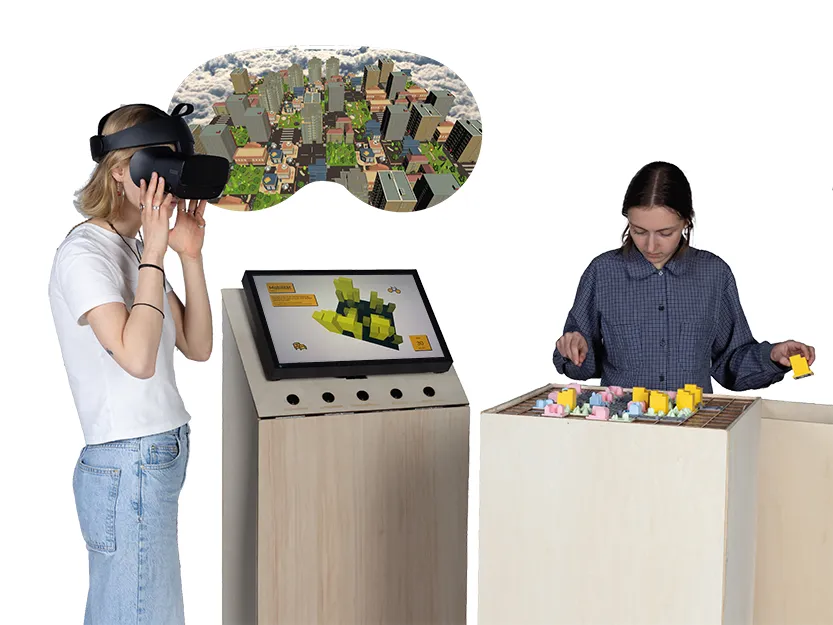
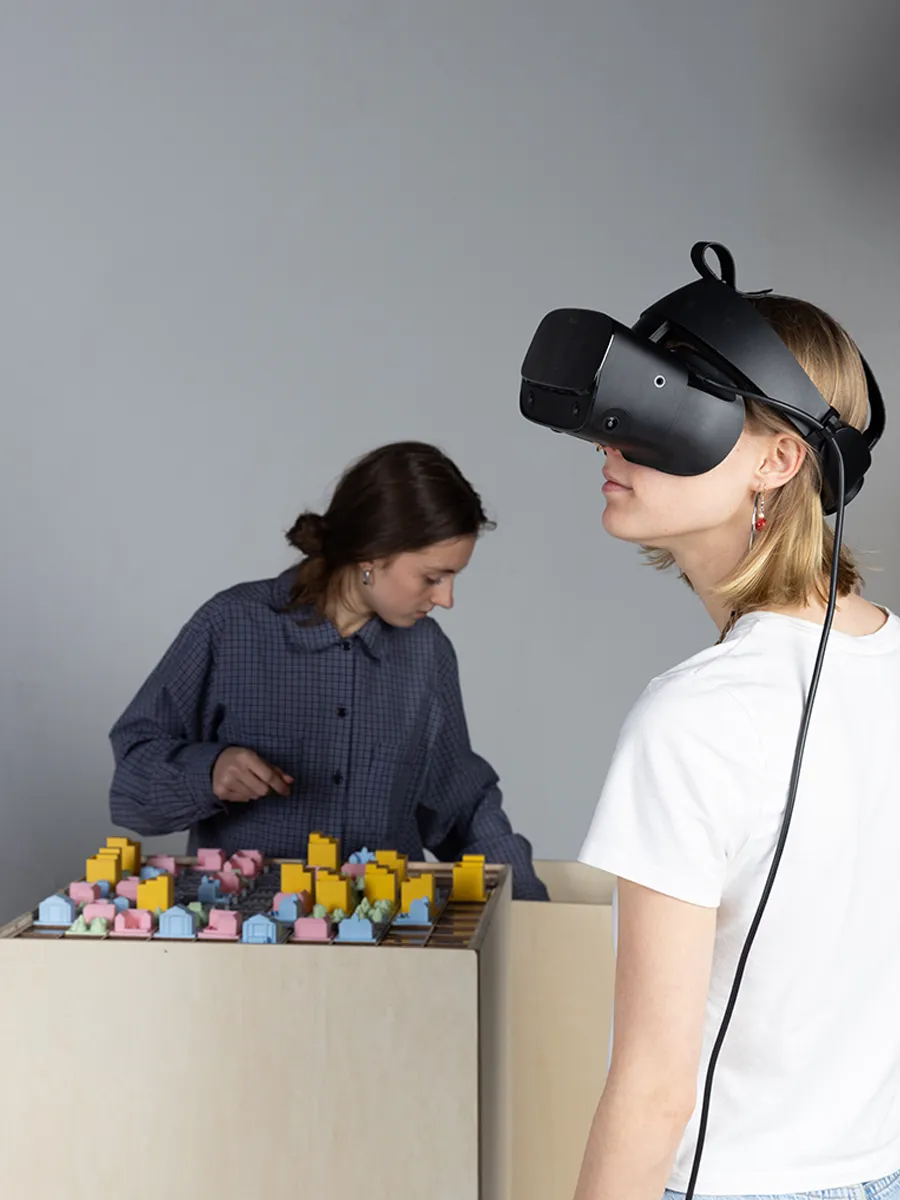
The installation was created as part of a collaboration between the Museum Management and Communication degree program, the Raumlabor design group, and the Alice Museum for Children at FEZ Berlin. For the “Green Planet Berlin” exhibition, which has been running since October 2025, we developed ideas, concepts, and prototypes for immersive installations. In doing so, we explored the theme of “ecosystems and urban space.” Our installation “Urbanova” allows children to learn in a playful way how urban planning influences the environment. On a grid with 100 fields, they can build and design their own city together. Using various game pieces (roads, apartment buildings, high-rises, parks, playgrounds, and cultural institutions such as schools, museums, and restaurants), they can arrange their city anywhere on the grid and change it at any time. An evaluation of the city is displayed on a screen in the form of a bar chart. There are four buttons that can be used to switch between different categories: energy consumption, biodiversity, quality of life, and mobility. The higher the bars and the brighter the colors on the grid, the better the city is developed in that area. The city can then be rebuilt in the dark areas so that as many bright areas as possible are achieved in each category. There is also an overall rating that evaluates the value of the city with up to 100 points.
With the help of VR glasses, you can fly through the city, which is now rendered more realistically with more color and detail. Children and young people can use this exhibit to learn how a city can be designed to be as sustainable and efficient as possible. They learn that all factors influence each other. I dealt with the technical connection between the analog installation, the evaluation, and the digital world. My task was to ensure that the stones are recognized by a camera as soon as they are placed on the playing field and that this information is forwarded to Unity. The camera is connected to a Python script that constantly updates a file with the grid information. This file is read by two different scripts in Unity. One script ensures that the correct game pieces are placed in the VR glasses. The second script assigns values to the individual stones depending on their category. These are then calculated together, which is how the graphics are displayed.